Why back pain happens
The spine is made of vertebrae separated by cushion-like discs, supported by muscles and ligaments. Back pain commonly comes from muscle strain, poor posture, heavy lifting or age-related wear. A slipped (prolapsed) disc happens when the soft inner part of a disc bulges out and presses on a nerve, which can cause pain spreading down the leg — known as sciatica — or down the arm from the neck.
Red-flag symptoms: get urgent care
- Weakness in the leg or foot, or foot drop
- Numbness around the genitals or buttocks
- Loss of bladder or bowel control
- Back pain after a significant fall or accident
- Back pain with fever, unexplained weight loss or a history of cancer
- Severe pain that does not ease with rest
Diagnosis
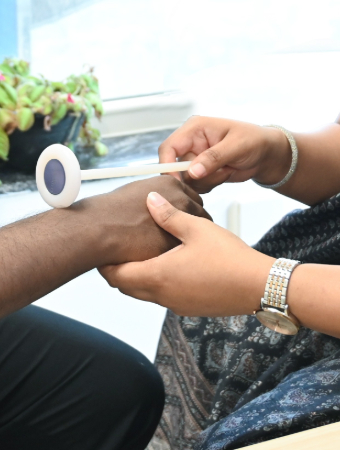
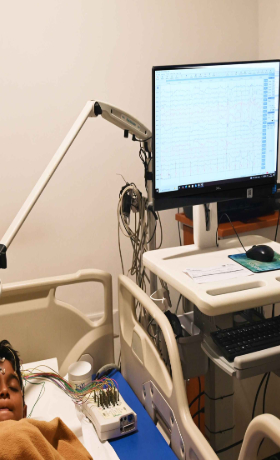
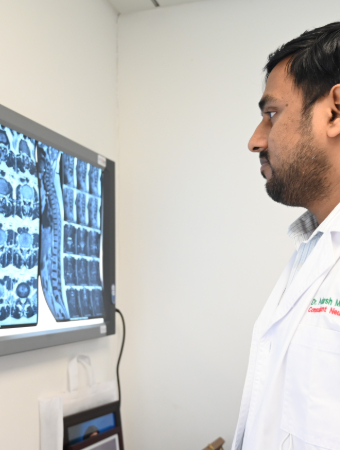
The doctor examines strength, reflexes and sensation. Imaging is not needed for every back pain, but when nerve compression or injury is suspected, MRI is the most useful test. Smita Memorial Hospital has a Philips 1.5T MRI and a Philips Incisive 128-slice CT scanner. Nerve conduction studies and EMG in the Neurology Lab can help assess nerve damage.
Non-surgical treatment comes first for most people
- Short rest followed by gradual return to activity
- Pain relief medicines as prescribed
- Physiotherapy — exercises to strengthen core and back muscles and improve posture
- Advice on lifting, sitting and sleeping positions
- Weight management and regular activity
Smita Memorial Hospital's Physiotherapy Department treats neck and back pain as part of musculoskeletal and sports rehabilitation, with equipment including a Balance Master, Kinesis resistance training and ARKE core training.
When surgery may be recommended
- Leg or arm weakness that is getting worse
- Bladder or bowel involvement
- Severe pain not improving after an adequate period of non-surgical treatment
- Spinal injury with instability
- Spinal tumours or infections
The Neurosurgery Department at Smita Memorial Hospital provides minimally invasive (keyhole) spine surgery, surgical management of spinal injuries with instrumentation and reconstruction, degenerative disc disease management, cranio-vertebral junction surgery and spinal cord tumour surgery. The Orthopaedics Department also treats disc prolapse, spinal fractures, spondylolisthesis and spine deformities, including spine fusion.
Recovery after spine surgery
- Most patients begin walking soon after keyhole surgery, as advised
- Physiotherapy is an important part of recovery
- Avoid heavy lifting and twisting for the period your surgeon recommends
- Report fever, wound discharge or new weakness
Everyday habits that protect your back
- Lift with your knees bent and the load close to your body; avoid twisting while lifting
- Take breaks from prolonged sitting — stand and walk every 30–45 minutes
- Set up your work desk so screens are at eye level
- Sleep on a supportive mattress
- Keep active — walking and core-strengthening exercises help
- Maintain a healthy weight
Neck pain and arm symptoms
Discs in the neck can also prolapse and press on nerves, causing pain, numbness or weakness spreading into the shoulder, arm or hand. Severe compression of the spinal cord in the neck can cause clumsiness of the hands, difficulty walking or balance problems — symptoms that need prompt specialist assessment. The Neurosurgery Department at Smita Memorial Hospital treats degenerative disc disease and cranio-vertebral junction problems, and the Neurology Lab performs nerve conduction studies to evaluate nerve damage.
Spinal injuries after falls and accidents
In hilly Idukki, falls from trees, rooftops and ladders and road accidents are important causes of spinal fractures. After such an injury, the neck and back should be kept still and the person moved only by trained help unless there is immediate danger. Smita Memorial Hospital's Emergency and Trauma Centre has a multidisciplinary trauma team including neurosurgery and orthopaedics, with CT and MRI, and the Neurosurgery Department provides surgical management of spinal injuries with instrumentation and reconstruction.
Recovery expectations after spine surgery
- Pain in the leg from nerve compression often improves quickly after decompression; numbness may take longer
- Muscle weakness recovers gradually and benefits from physiotherapy
- A structured return to work depends on the job and the type of surgery
- Maintaining core strength and good posture reduces the risk of future problems
Specialists you can consult

Frequently asked questions
Does every slip disc need surgery?
No. Most people improve with rest, medicines and physiotherapy. Surgery is considered for nerve weakness, bladder or bowel problems, or severe pain that does not improve.
Is keyhole spine surgery available in Thodupuzha?
Yes. Smita Memorial Hospital's Neurosurgery Department performs minimally invasive (keyhole) spine surgery.
Should I get an MRI for back pain?
Not always. Your doctor will advise an MRI if there are nerve symptoms, red flags or pain that does not improve.
Where is physiotherapy at Smita Hospital?
On the 10th floor, Monday to Saturday, 9:00 AM to 5:30 PM. Appointments are required for OPD.
Sources
- Neurosurgery, smitahospital.com
- Orthopaedics, smitahospital.com
- Physiotherapy, smitahospital.com