What is a stroke?
The brain needs a constant supply of oxygen-rich blood. A stroke — sometimes called a brain attack — occurs when that supply is interrupted. Brain cells in the affected area begin to be damaged within minutes, which is why stroke is a medical emergency.
- Ischaemic stroke — the most common type — happens when a clot blocks an artery supplying the brain
- Haemorrhagic stroke happens when a blood vessel in or around the brain bursts and bleeds
- A transient ischaemic attack (TIA), or mini-stroke, causes stroke symptoms that disappear on their own — but it is a warning sign that needs urgent assessment
Recognise it with BE FAST
- B — Balance: sudden loss of balance, dizziness or difficulty walking
- E — Eyes: sudden loss of vision or double vision
- F — Face: one side of the face droops; the smile is uneven
- A — Arms: weakness or numbness in one arm or leg
- S — Speech: slurred speech, difficulty finding words or understanding
- T — Time: call for help immediately and note the time symptoms started
Other warning signs include a sudden severe headache unlike any before, sudden confusion, or sudden numbness of one side of the body.
Why time matters
The main emergency treatments for ischaemic stroke — clot-dissolving medicine (thrombolysis) and clot removal (mechanical thrombectomy) — can only be given within certain time windows after symptoms start. The earlier a patient reaches a hospital with a stroke team and imaging, the more treatment options are available and the more brain tissue can be saved.
- Do not wait to see if symptoms settle
- Do not give the person food, water or medicines by mouth — swallowing may be affected
- Do not try home remedies
- Keep the person lying comfortably with the head slightly raised, and stay with them
What happens at the hospital
Smita Memorial Hospital's Department of Neurology runs 24-hour stroke services. The Emergency and Trauma Centre has CT and MRI facilities for rapid brain imaging, which shows whether a stroke is caused by a clot or by bleeding — a crucial difference, because the treatments are opposite.
- Rapid assessment of symptoms, blood pressure, blood sugar and heart rhythm
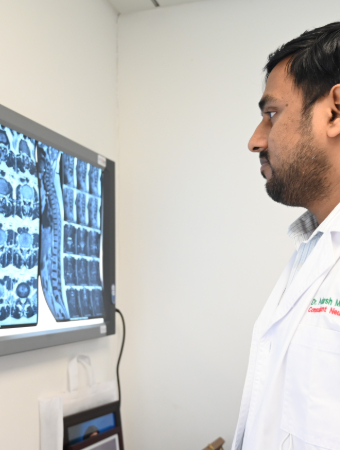
- Urgent CT or MRI brain scan
- Thrombolysis — a clot-dissolving medicine — for suitable ischaemic strokes within the treatment window
- Mechanical thrombectomy by the Interventional Radiology team, where a catheter removes the clot from a large brain artery
- Admission to the Neuro ICU or neurology ward for monitoring
For bleeding strokes, the Neurosurgery Department provides open and endoscopic procedures, including decompressive craniotomy and endoscopic evacuation of intracerebral haematoma, with care in a 5-bed Neurosurgical ICU.
Recovery and rehabilitation
Recovery often continues for months after a stroke. Rehabilitation helps people regain movement, speech, swallowing and independence. At Smita Memorial Hospital, neuro-rehabilitation is provided with the Department of Physical Medicine and Rehabilitation, and the Physiotherapy Department offers neurological rehabilitation for stroke. The Audiology and Speech team provides therapy for aphasia, dysarthria and swallowing difficulty (dysphagia).
- Take medicines to prevent another stroke exactly as prescribed
- Control blood pressure, diabetes and cholesterol
- Stop smoking and limit alcohol
- Have heart rhythm problems such as atrial fibrillation evaluated and treated
- Stay active as advised by your rehabilitation team
Stroke risk factors you can control
- High blood pressure — the single most important controllable risk factor
- Atrial fibrillation — an irregular heartbeat that can cause clots to form in the heart and travel to the brain
- Diabetes
- High cholesterol
- Smoking and heavy alcohol use
- Physical inactivity and excess weight
Regular blood pressure checks and treatment are among the most effective ways to prevent stroke. If you feel an irregular pulse or palpitations, have an ECG done.
What happens in the first days after a stroke
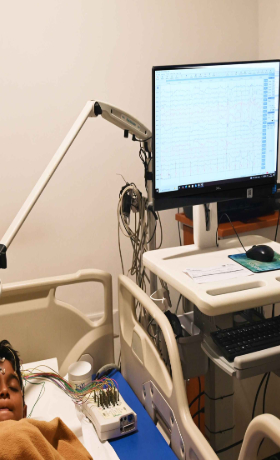
In the Neuro ICU or neurology ward, the team monitors blood pressure, breathing, swallowing and neurological changes. Swallowing is checked before food or drink is given, because stroke can affect swallowing and cause choking or chest infection. Tests look for the cause — such as heart rhythm monitoring, echocardiography and imaging of the neck arteries — so that the right medicines can prevent another stroke.
Early rehabilitation begins once the patient is stable: positioning to prevent stiffness and pressure sores, sitting out of bed, and early physiotherapy and speech assessment.
Supporting a family member after stroke
- Learn the exercises the physiotherapist teaches and help practise them daily
- Speak slowly and give time to respond if speech is affected
- Make the home safe — clear pathways, grab bars and good lighting
- Watch for low mood, which is common after stroke and treatable
- Ensure medicines are taken regularly
- Look after your own health and ask for help
Carotid and brain artery narrowing
Some strokes are caused by narrowed arteries in the neck (carotid arteries) or inside the skull. Smita Memorial Hospital's Interventional Radiology department lists carotid and vertebral artery angioplasty and stenting, and intracranial angioplasty and stenting, among its services, as well as treatment of brain aneurysms and arteriovenous malformations. Your neurologist will advise whether such treatment is relevant.
Specialists you can consult
Dr. Prashanth Poulose
MBBS, MD (Internal Medicine), DM (Medical Neurology), Post doctoral fellowship…
Frequently asked questions
Is stroke treatment available 24 hours in Thodupuzha?
Yes. Smita Memorial Hospital provides 24-hour stroke services including thrombolysis, with CT and MRI imaging and an interventional radiology team for thrombectomy.
What is mechanical thrombectomy?
A procedure in which a catheter is passed through an artery to the brain to remove the clot causing a stroke. It is performed by interventional radiologists in the cath lab.
Should I give aspirin if I suspect a stroke?
No. Some strokes are caused by bleeding, and aspirin can make them worse. Do not give any medicine by mouth; bring the person to hospital for a brain scan first.
Can a mini-stroke be ignored if symptoms go away?
No. A TIA is a warning that a major stroke may follow. It needs urgent medical assessment.
Sources
- Department of Neurology, smitahospital.com
- Interventional Radiology, smitahospital.com
- Neurosurgery, smitahospital.com