
About Interventional Radiology at Smita Memorial Hospital
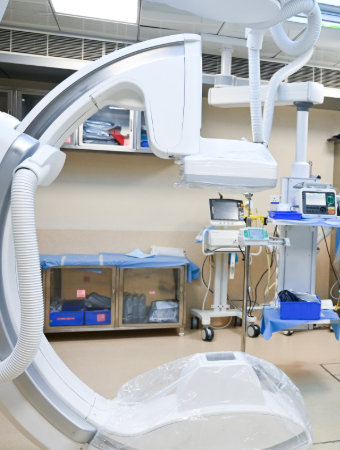
Interventional Radiology (IR) uses minimally invasive, image-guided procedures to diagnose and treat conditions across almost every organ system. Procedures are performed in the catheterisation laboratory using fine needles, guidewires and catheters inserted through a small skin puncture — usually in the groin — under real-time fluoroscopy, ultrasound or CT guidance.
IR plays a vital role in vascular emergencies such as stroke and internal bleeding, and supports many medical and surgical specialties. Beyond vascular work, the department performs image-guided tumour ablation, biopsies and stent placement. Compared with open surgery, patients typically benefit from very small incisions, a shorter hospital stay, faster recovery and a lower risk of infection.
Interventional Radiology treatments & services
Stroke & neurovascular
Mechanical thrombectomy, intra-arterial thrombolysis, carotid/vertebral and intracranial angioplasty and stenting, brain aneurysm treatment, CNS AVM and AV fistula treatment, venous sinus thrombosis and vasospasm treatment.
Diagnostic angiography
Cerebral and spinal angiography, and inferior petrosal sinus sampling (IPSS).
Bleeding control
Embolisation for nosebleeds (epistaxis), haemoptysis, GI bleeding, and traumatic liver, spleen, pelvic and facial injuries; middle meningeal artery embolisation for SDH.
Women's & men's health
Uterine artery embolisation for fibroids and prostatic artery embolisation for BPH.
Cancer care
Trans-arterial chemoembolisation (TACE) for liver tumours, RFA/microwave ablation, tumour embolisation and intra-arterial chemotherapy for retinoblastoma.
Vascular malformations
Sclerotherapy for venous and lymphatic malformations.
When should you see a specialist?
Consider booking a consultation if you notice any of the following. This is general guidance, not a diagnosis.
- Sudden weakness, facial droop or speech difficulty — stroke needs emergency treatment within hours
- You have been diagnosed with a brain aneurysm or AVM
- Heavy periods due to fibroids and you want to avoid hysterectomy
- Urinary symptoms from an enlarged prostate
- Liver tumours where surgery is not suitable
Interventional Radiology doctors in Thodupuzha

Dr. Soumya Ranjan Malla
MBBS, MD (Radiodiagnosis), DM (Neuroimaging & Interventional Neuroradiology)…
Interventional Radiology — frequently asked questions
What is mechanical thrombectomy?
It is a procedure in which a catheter is passed through an artery to the brain to physically remove the clot causing a stroke. It is time-critical, so anyone with stroke symptoms should come to emergency immediately.
Can fibroids be treated without surgery?
Uterine artery embolisation blocks the blood supply to fibroids so they shrink. It is performed through a small puncture and is available in the Interventional Radiology department.
Is interventional radiology safer than open surgery?
IR procedures use very small incisions, so they generally mean shorter hospital stays, faster recovery and a lower risk of infection. Your doctor will advise which approach is best for your condition.
Where are IR procedures performed?
In the hospital's catheterisation laboratory, which is equipped with the Philips Azurion 7C20 system for complex cardiac, neuro and vascular procedures.