What is a heart attack?
The heart muscle receives oxygen-rich blood through the coronary arteries. Over years, fatty deposits called plaque can build up inside these arteries. If a plaque cracks, a blood clot forms on it and can suddenly block the artery. The part of the heart muscle supplied by that artery starts to lose oxygen, and if blood flow is not restored, the muscle begins to die.
The medical name for a heart attack is myocardial infarction. Doctors often classify it by the ECG pattern. One type, known as STEMI, usually means a coronary artery is completely blocked and needs the artery to be opened as quickly as possible. Other types still need urgent hospital treatment, and the cardiologist decides the timing of further procedures.
Why time matters so much
Heart muscle damage progresses with every minute an artery stays blocked. The faster blood flow is restored, the more heart muscle can be saved — which affects how well the heart pumps afterwards and the risk of complications such as heart failure and dangerous rhythm problems. Cardiologists often say that time is muscle.
The biggest delays usually happen before a patient reaches hospital: waiting to see if pain goes away, trying home remedies, or travelling to a centre that cannot perform angioplasty and then needing a transfer. For families in the Idukki high ranges, knowing in advance where 24×7 angioplasty is available can save critical time.
Recognising a heart attack
- Chest pain, pressure, heaviness or tightness lasting more than a few minutes
- Pain spreading to the arm, jaw, neck, back or upper abdomen
- Breathlessness, sweating, nausea or vomiting
- Light-headedness, fainting or sudden weakness
- In some people — particularly older adults, women and people with diabetes — only tiredness, breathlessness or mild discomfort
What is primary angioplasty?
Primary angioplasty — also called primary PCI (percutaneous coronary intervention) — is an emergency procedure to open the blocked artery causing a heart attack. It is done in a cardiac catheterisation lab (cath lab) by an interventional cardiologist.
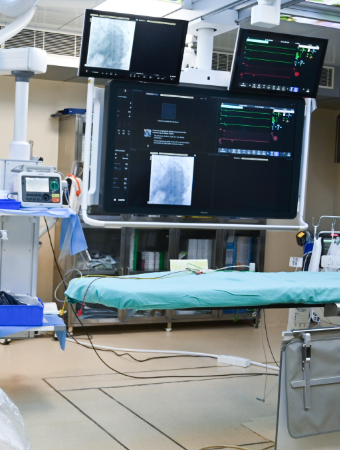
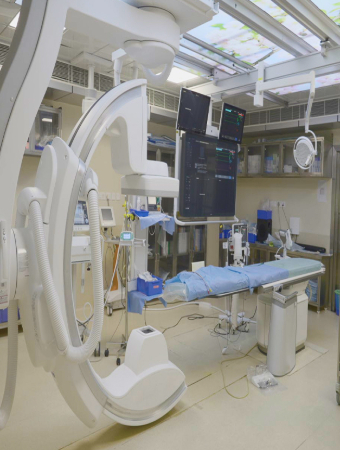
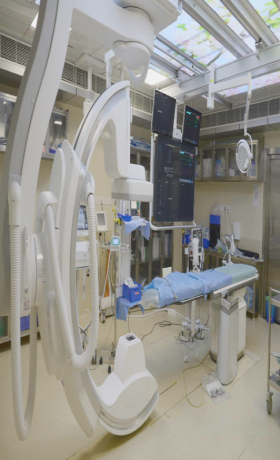
Smita Memorial Hospital provides 24×7 primary angioplasty in a cath lab equipped with the Philips Azurion 7C20 system with FlexVision, which allows complex cardiac, neuro and vascular procedures. The Department of Cardiac Sciences follows American Heart Association (AHA) guidelines for cardiac procedures.
How the procedure is done, step by step
- The patient is assessed in emergency and an ECG confirms the type of heart attack
- Blood-thinning medicines are given as decided by the cardiologist
- In the cath lab, the wrist or groin area is numbed with local anaesthetic; the patient usually stays awake
- A thin, flexible tube (catheter) is guided through the artery to the heart
- Contrast dye is injected and X-ray images (a coronary angiogram) show the exact blockage
- A fine wire crosses the blockage and a small balloon is inflated to open the artery
- In most cases a stent — a small mesh tube — is placed to keep the artery open
- Blood flow is checked on the screen, the catheter is removed, and the patient moves to the Coronary Care Unit
For complex blockages, cardiologists may use additional tools. The department's listed capabilities include intravascular ultrasound (IVUS), fractional flow reserve (FFR), rotablation for heavily calcified arteries, intracoronary lithotripsy, optical coherence tomography (OCT), and complex stenting for left main, bifurcation and chronic total occlusion blockages.
After angioplasty: the CCU and recovery
After the procedure, patients are monitored closely. Smita Memorial Hospital has an 8-bed Coronary Care Unit (CCU) as part of its 54 critical care beds. Nurses and doctors watch heart rhythm, blood pressure and the puncture site, and adjust medicines.
Most people begin sitting up and walking within a short time, depending on their condition. Before discharge the cardiologist explains the medicines — especially blood thinners that protect the stent — and the follow-up plan.
- Take blood-thinning medicines exactly as prescribed; never stop them on your own
- Attend follow-up visits and cardiac rehabilitation if advised
- Control blood pressure, sugar and cholesterol
- Stop smoking completely
- Return to work, driving and exercise only as your doctor advises
Smita Memorial Hospital's Physiotherapy Department offers cardiac rehabilitation after heart procedures, including exercise testing and stress reduction.
Is angioplasty always the treatment?
Not always. The treatment depends on the type of heart attack, the pattern of blockages seen on the angiogram and the patient's overall health. Some patients are best treated with medicines; others may need coronary artery bypass surgery (CABG), particularly when several arteries are severely diseased. Smita Memorial Hospital's Cardiothoracic Surgery Department performed the first heart bypass and valve surgery in the Idukki region and has round-the-clock cardiac theatre facilities, including for managing angioplasty complications.
Understanding the stent
A stent is a tiny expandable metal mesh tube mounted on a balloon. When the balloon is inflated inside the narrowed artery, the stent opens and presses against the artery wall, holding it open like scaffolding. Most stents used today release a medicine slowly into the artery wall to reduce the chance of the artery narrowing again.
The Department of Cardiac Sciences at Smita Memorial Hospital also lists new-generation bioabsorbable stent implantation among the procedures it pioneered in Idukki district. Your cardiologist chooses the stent type based on the artery and your condition.
Why blood-thinning medicines matter so much afterwards
After a stent is placed, the body treats it as a foreign surface until the artery lining grows over it. During this time, blood clots can form on the stent. Antiplatelet medicines prevent this. Stopping them early — even for a few days, or before a dental or surgical procedure without asking your cardiologist — can cause a sudden, dangerous blockage of the stent.
- Never stop blood thinners unless your cardiologist tells you to
- Tell any dentist or surgeon that you have a stent before any procedure
- Report unusual bleeding, black stools or blood in urine promptly
- Keep enough medicine so you never run out — the hospital pharmacy runs 24×7 and offers free home delivery for orders above ₹500 with a prescription
Complications doctors watch for
Most people recover well, but a heart attack can have complications, particularly in the first days. This is why patients are monitored in the Coronary Care Unit.
- Irregular or dangerous heart rhythms
- Heart failure if a large area of muscle was damaged
- Bleeding at the puncture site
- Chest pain returning, which may signal a new blockage
- Low mood or anxiety afterwards — common and treatable
An echocardiogram before discharge shows how well the heart is pumping and helps plan medicines and rehabilitation.
Returning to normal life
Recovery is gradual. Many people return to light daily activities within days and to work over the following weeks, depending on the extent of damage and the type of job. Driving, travel and sexual activity should be discussed with your cardiologist, who can advise based on your recovery.
- Walk a little more each day as advised
- Eat a heart-healthy diet with less salt, fried food and sugar
- Stop smoking completely and avoid second-hand smoke
- Keep blood pressure, sugar and cholesterol at targets
- Join cardiac rehabilitation — it builds fitness safely and reduces anxiety
Specialists you can consult
Frequently asked questions
Is primary angioplasty available at night in Thodupuzha?
Yes. Smita Memorial Hospital provides 24×7 primary angioplasty in its Philips Azurion 7C20 cath lab.
Will I be awake during angioplasty?
Usually yes. The procedure is typically done under local anaesthetic at the wrist or groin, with medicines to keep you comfortable.
How long does a stent last?
A stent is designed to stay permanently in the artery. Taking the prescribed blood thinners and controlling risk factors helps keep the artery open over the long term.
Is angioplasty covered by insurance?
Smita Memorial Hospital is empanelled with Medisep, ECHS, CGHS and a large panel of insurers and TPAs. In an emergency ICU admission the patient can be admitted with the TPA ID card and a ₹10,000 deposit, and the cashless process is completed within 24 hours.
Sources
- Department of Cardiac Sciences, smitahospital.com
- Cath Lab, smitahospital.com
- Critical Care, smitahospital.com