Why newborns get jaundice
Jaundice is caused by a yellow substance called bilirubin, which is produced when red blood cells break down. A newborn's liver is still maturing and cannot clear bilirubin quickly, so it builds up and shows as yellowing of the skin and eyes. This is called physiological jaundice and usually appears after the first day and fades within a couple of weeks.
Signs that need a doctor today
- Jaundice in the first 24 hours after birth
- Yellow colour spreading to the tummy, arms or legs
- The baby is very sleepy, difficult to wake or feeding poorly
- Very high-pitched crying, arching of the back or floppiness
- Pale or chalky stools, or dark urine
- Jaundice lasting beyond two weeks (three weeks in premature babies)
- Fever or signs of illness along with jaundice
Babies at higher risk
- Premature babies
- Babies with a different blood group from the mother
- Babies who are not feeding well
- Babies with bruising from birth
- Babies with a sibling who needed jaundice treatment
How jaundice is checked and treated
A blood test measures bilirubin. The level is compared with the baby's age in hours and risk factors to decide whether treatment is needed.
- Phototherapy — the baby is placed under special blue light that helps break down bilirubin; eyes are protected
- Frequent feeding to help the baby pass bilirubin
- Exchange transfusion for very high or rapidly rising levels
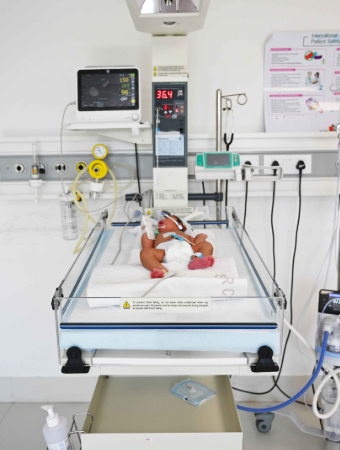
Smita Memorial Hospital's Neonatology Department has 6 LED phototherapy units for neonatal jaundice and performs exchange transfusion. The 7-bed NICU also provides in-house neurosonography, portable X-ray and arterial blood gas testing.
Caring for your baby at home
- Feed often — breastfeed on demand, at least every two to three hours
- Check skin colour in natural daylight
- Count wet nappies and watch stool colour
- Keep follow-up appointments for bilirubin checks
- Do not rely on sunlight exposure as a treatment
Breastfeeding and jaundice
Good feeding is one of the best ways to help a baby clear bilirubin, because bilirubin leaves the body through stools. In the first days, some babies with jaundice are sleepy and do not feed well, which can make jaundice worse. Wake the baby for feeds if needed and ask the nurses for help with latch and positioning.
A small number of breastfed babies have mild jaundice that lasts longer while they otherwise thrive. This still needs a doctor to check that there is no other cause, but it usually does not mean stopping breastfeeding.
Why prolonged jaundice needs tests
Jaundice that lasts beyond two weeks in term babies, or three weeks in premature babies, needs evaluation. Most of the time the cause is harmless, but tests help rule out conditions such as infections, thyroid problems and, importantly, problems with bile drainage from the liver. Pale, chalky stools or dark urine are particularly important signs and should be reported promptly.
What phototherapy is like for your baby
- The baby lies under special blue LED lights wearing only a nappy, with eyes protected
- The skin is exposed to as much light as possible
- Treatment is usually continuous, with short breaks for feeding and care
- Bilirubin levels are rechecked to decide when to stop
- Most babies need phototherapy for a limited period
Phototherapy is safe and effective. The light does not hurt the baby.
When jaundice becomes dangerous
Very high bilirubin can pass into the brain and cause damage, which is why rapidly rising or very high levels are treated urgently — sometimes with exchange transfusion, in which the baby's blood is gradually replaced to remove bilirubin. Early detection and treatment prevent this. Smita Memorial Hospital's NICU performs exchange transfusion when needed and has blood support from its 24×7 Blood Centre.
Frequently asked questions
Is newborn jaundice common?
Yes, many newborns have mild jaundice that settles on its own. Jaundice in the first 24 hours or that spreads or persists needs medical review.
Does sunlight cure jaundice?
Sunlight is not a safe or reliable treatment. If jaundice is significant, medical phototherapy is used.
Does Smita Hospital have phototherapy?
Yes. The Neonatology Department has 6 LED phototherapy units and a 7-bed NICU.
Should I stop breastfeeding if my baby has jaundice?
Usually no. Frequent feeding helps. Follow your doctor's advice.
Sources
- Neonatology, smitahospital.com
- Pediatrics, smitahospital.com